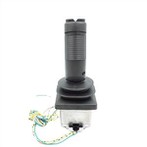
In the application of industrial operating handles, there are two main output forms used by electronic control handles: potentiometer-type output and Hall-type output.
The difference between the potentiometer type and the Hall type has been described in the previous article, which is roughly as follows:
Hall type is characterized by active, non-contact operation, and the life can be made longer. Not suitable for use in occasions with metal dust.
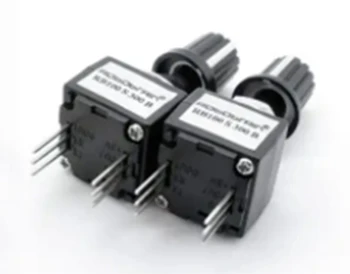
Hall type potentiometer
The potentiometer type is characterized by passive, contact-type operation, and its stability relative to the Hall will be better. Not suitable for particularly frequent operations and equipment that is used a lot.
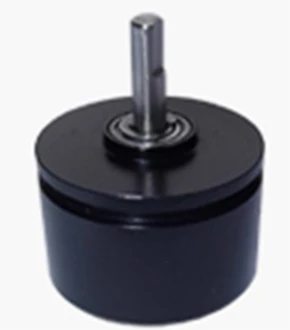
Angle potentiometer
In this issue, we will explain in detail how the potentiometer is used.
The function of a potentiometer is to manually change the resistance in the circuit or measure the potential difference across the circuit; therefore, the potentiometer is called a voltage metering device. Potentiometers are passive electronic devices, i.e. they do not generate energy, they only store or dissipate energy in the form of electrical current. A potentiometer is a versatile device; it is used for other purposes besides measuring potential differences, such as dividing voltages, comparing the electromotive force of batteries, and as a variable resistor.
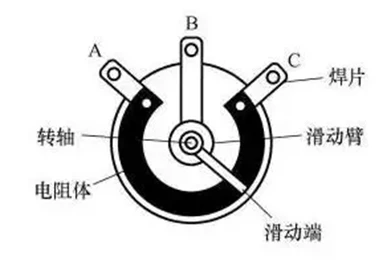
As shown above, if a constant current flows through the resistor body, the voltage drop across any part of the uniform resistor body is proportional to the length of the wiper (ideally). Therefore, if the potential difference between any two parts of the wiper is zero, no current flows through the circuit. In a potentiometer, the input voltage is applied to the entire length of the resistance wire and the output voltage is measured between the sliding contact and the fixed end of the circuit. The position of the adjuster (sliding contact) is varied over the length of the uniform resistance wire to find the zero position.
The potentiometer type is usually used in occasions where the relative operation accuracy is high and the frequency of use is not particularly high, such as cranes, mine machinery, road machinery, etc. Generally speaking, the potentiometer type needs to pay attention to its wiring method in use. If the wrong wiring method is used, the potentiometer may be short-circuited at a specific position, resulting in an instantaneous high current and the phenomenon of burning the potentiometer.
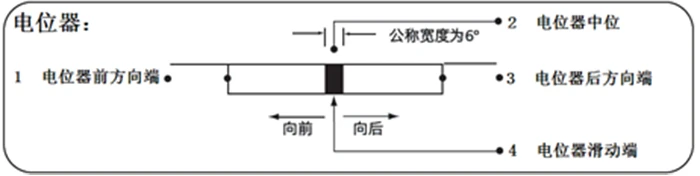
Figure 1 Potentiometer with neutral lead
The above picture is the usual wiring method of the potentiometer (it should be noted that in some cases, the wiring will be different according to the manufacturer, and the No. 2 neutral end and the No. 4 sliding end are reversed, as shown in Figure 2). The dead zone of the potentiometer ( The range in which the voltage output does not change) has a difference of ±2~3° according to the selection of the potentiometer.
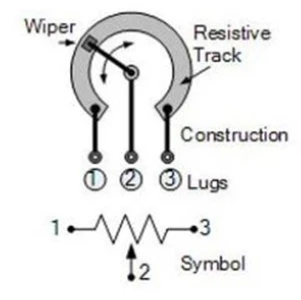
Figure 2 Potentiometer without neutral lead
In addition, if it is a three-pin potentiometer, the wiring is as shown above.
Potentiometers are classified according to the realization mechanism: 1. Carbon film potentiometer; 2. Organic solid core potentiometer; 3. Metal film potentiometer; 4. Wire wound potentiometer; 5. Contactless potentiometer and so on.

1. Most of the potentiometers used on industrial handles are carbon film potentiometers or metal film potentiometers. They change the resistance value by sliding a brush or a sliding rod on the carbon film. The key technological difficulty is the carbon film. On the film, the carbon film of the resistor body is made of ground carbon black, graphite, quartz and other materials coated on the surface of the substrate. It is characterized by high resolution, good wear resistance and long service life. The disadvantages are current noise, slightly poor linearity, poor moisture resistance and resistance stability.
2. Since the industrial handle requires a certain life expectancy, and requires a certain operating precision and accuracy, the use of carbon film potentiometers or metal film potentiometers can take into account both the service life and operating accuracy, relative linearity effects and current noise. In industrial use, the impact is small, and the potentiometer itself and the handle itself will be protected against dust and water, so the disadvantage of moisture resistance will not exist.
3. Potentiometers usually fail as follows according to their use environment:
4. 1. The burn-out potentiometer caused by the wiring error is externally manifested as sparks or blackening of the potentiometer, heat and burn-out.
5. 2. Poor contact or breakpoints caused by damage to the carbon film can be measured by capturing waveforms with an oscilloscope.
6. The brush plate is rerouted or deformed, usually manifested as a change in linear output or no output.
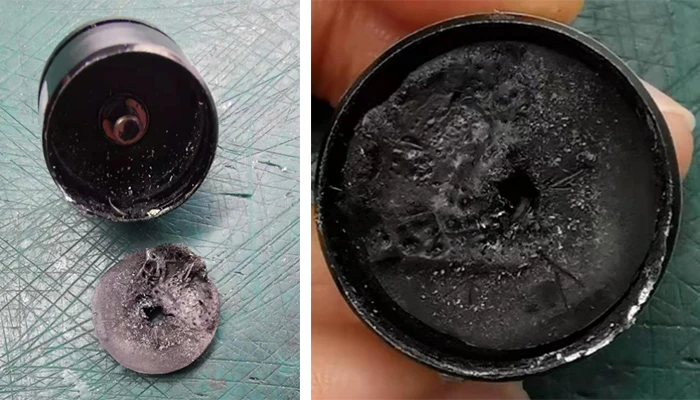
Potentiometer burnout
If the above situation occurs, please contact the manufacturer to replace the potentiometer or maintain the joystick.